
The Higher Education Sector Just Got a Wake-Up Call
Earlier this year, Moody’s Investors Service downgraded its financial outlook for U.S. higher education from “stable” to “negative.” The reason? A rising storm of federal policy shifts, disrupted funding flows, and regulatory volatility that’s pushing institutions—especially public colleges and research-driven universities—into uncharted fiscal territory.
But here’s the thing: While Moody’s assessment focused on traditional financial levers like endowments and debt, the real opportunity for resilience may lie elsewhere—in curriculum.
Why the Downgrade Matters to Every Campus
The report signals more than just trouble for elite institutions with $1B+ budgets. It’s a systemic red flag.
Key threats called out by Moody’s include:
- Proposed endowment tax hikes and research funding cuts
- Delays in federal student aid disbursements
- Enforcement against DEI programs and international visa risk
- Unstable access to capital and weakened credit ratings
Each of these threats reverberates across academic strategy, enrollment management, program planning, and financial forecasting.
What’s Really at Stake? Five Institutional Vulnerabilities
Based on Moody’s report and Acadea’s research, here are the key downstream risks for institutions and how curriculum management plays a pivotal role in addressing them:
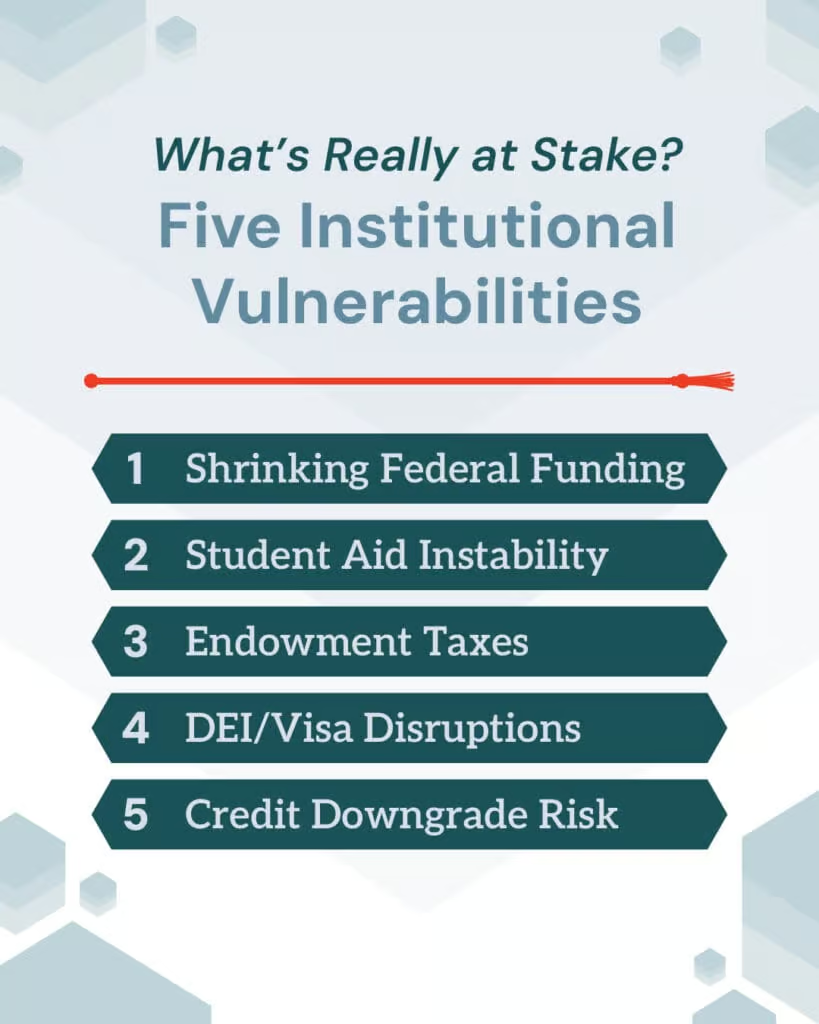
1. Shrinking Federal Funding → ROI-Driven Program Planning
Research institutions could lose over $100M annually from NIH cost cap policies. In this environment, it’s essential to measure curriculum ROI at the program level, reallocate resources with precision, and sunset low-impact offerings early.
2. Student Aid Instability → Enrollment Volatility
Delays or reductions in federal aid directly impact enrollment and retention. Institutions must build real-time scenario models for academic and financial planning and ensure their curricular pathways remain accessible and efficient.
3. Endowment Taxes → Capital Spend Scrutiny
With reserves under threat, every new program, proposal, and catalog update must be tightly aligned with institutional goals, workforce needs, and ROI potential.
4. DEI/Visa Disruptions → Pipeline Risk
As policy enforcement targets DEI and international enrollment, institutions need the ability to pivot quickly, realigning programs, mapping student pathways, and ensuring governance is responsive, not reactive.
5. Credit Downgrade Risk → Strategic Discipline
Bond agencies want proof that your institution can flex and adapt. Transparent, auditable academic planning—powered by real-time data—sends a strong message of strategic maturity.
What Institutions Can Do Now: Shift to Strategic Academic Operations
Here’s where the rubber meets the road. Your curriculum isn’t just a catalog, it’s your most powerful lever for controlling risk, recovering time, and demonstrating value.
Acadea helps institutions transition from fragmented, manual curriculum workflows to what we call Strategic Academic Operations. This approach equips schools to:
- Reclaim 28,000+ hours annually across departments
- Reduce curriculum approval times by up to 70%
- Replace 90% of spreadsheet-based tracking with integrated, audit-ready tools
- Achieve full ROI in under 40 proposals, often within a single department
- Unlock over $1M in annual value through smarter operations
Strategic Recommendations
Based on Moody’s findings, here’s how your institution can respond today:
| Threat | Strategic Response |
|---|---|
| Aid disbursement delays | Integrate curriculum workflows with enrollment and financial planning systems. |
| Capital strain | Use scenario-based planning tools to test program expansion vs. freeze decisions. |
| DEI/visa pressure | Create agile program structures that support equity without policy dependency. |
| Credit downgrades | Demonstrate planning rigor through curriculum lifecycle visibility and governance logs. |
Final Takeaway
Moody’s downgrade isn’t just a signal of trouble; it’s a call to action. The most resilient institutions will be those that treat academic operations as a strategic capability, not a background process.
At Acadea, we’re not just here to help you manage curriculum. We’re here to help you lead with it.